Six Hours, Part 6

The skylights

After we passed the fumarole skylights, we went a quarter mile in the dark; the only sound was dripping condensation. The guide lagged until the cavern roof sloped down low; then he brushed past and held up a warding hand into Alyx’s flashlight beam. He got down and crawled ahead, dragging the toad bag.

We waited a good ten minutes.

When he came back, the bag was empty. “Go on. He won’t bite.”

I’d like to tell you how the meeting went. Alyx is still buzzing.

But that would be against the rules.

The meeting

Posted in Fantasy, Monsters, Precambrian Conspiracy | Tagged | Leave a comment

Six Hours, Part 5

The fumarole

We headed back west, into forest on the lee of Three-Fingered Jack. The road was tough for the Civic. I kept stealing looks at the bagged toad in the guide’s lap. Finally, he signaled a stop at no place in particular. “Do you have any flashlights?”

I told him I did. There was one on my phone, and I took one from the glove box and gave it to Alyx.

As we got out, I noticed a four-inch pit in the dust. Alyx had never heard of antlions. I caught an ant and tried to demonstrate. I kept dropping the ant in the pit, but the antlion wasn’t hungry, so I dug him up to show her. Alyx was impressed and a little repulsed as it humped across my palm.

The guide started off without us, toad bag swinging in his grip, and we had to catch up. We passed from pine-needle duff to bracken and into a fir grove that was incongruous among the old pines. The air became cool, and strangely thick. I got light-headed. It was very odd.

“Lots of oxygen here,” said the guide. “They need it to grow so big. Usually, they mindfog people wandering in, to redirect them, but they know me.”

We paused after a climb, and Alyx sat on a rock. She noticed it had a deep cleft.

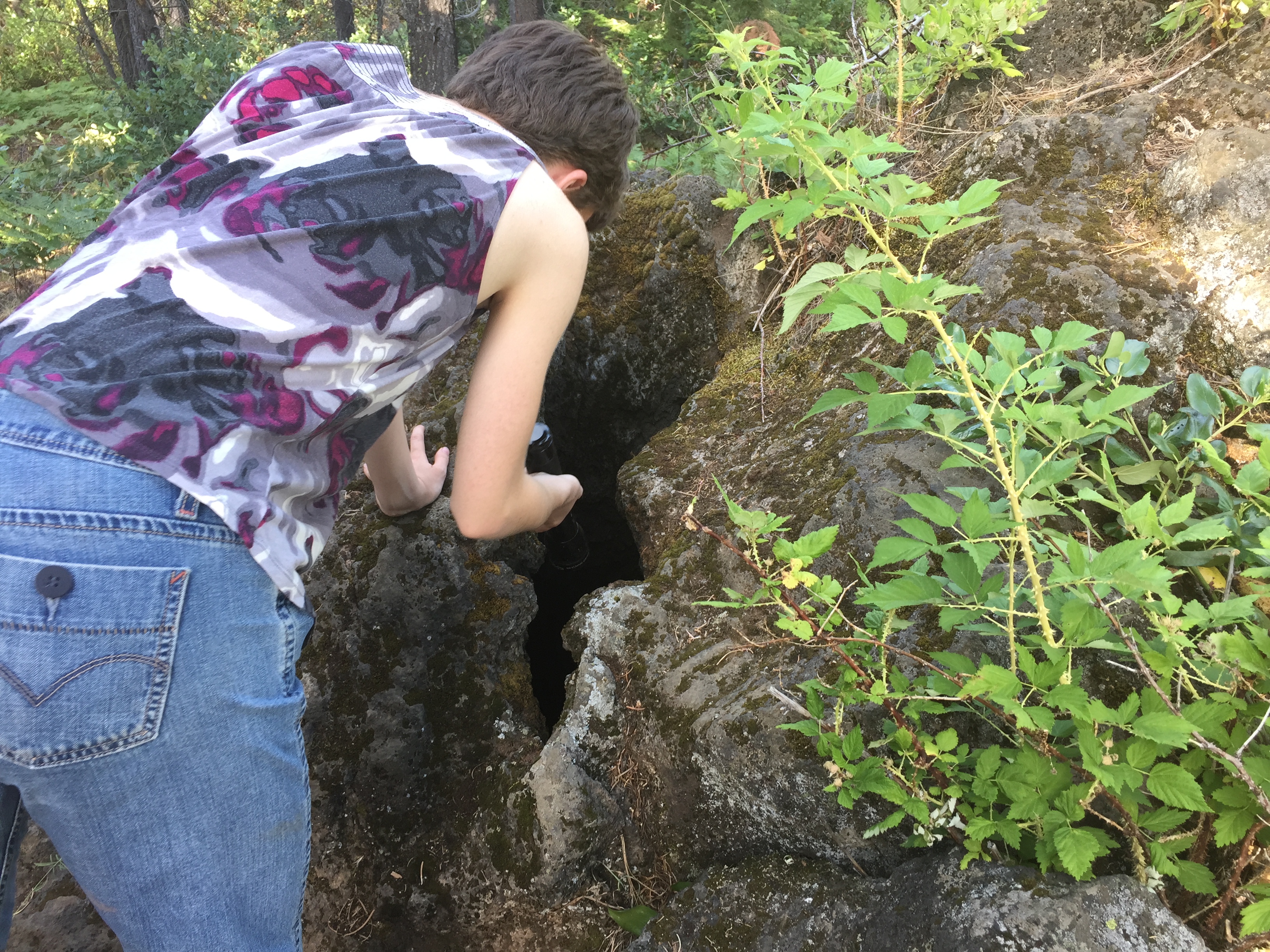
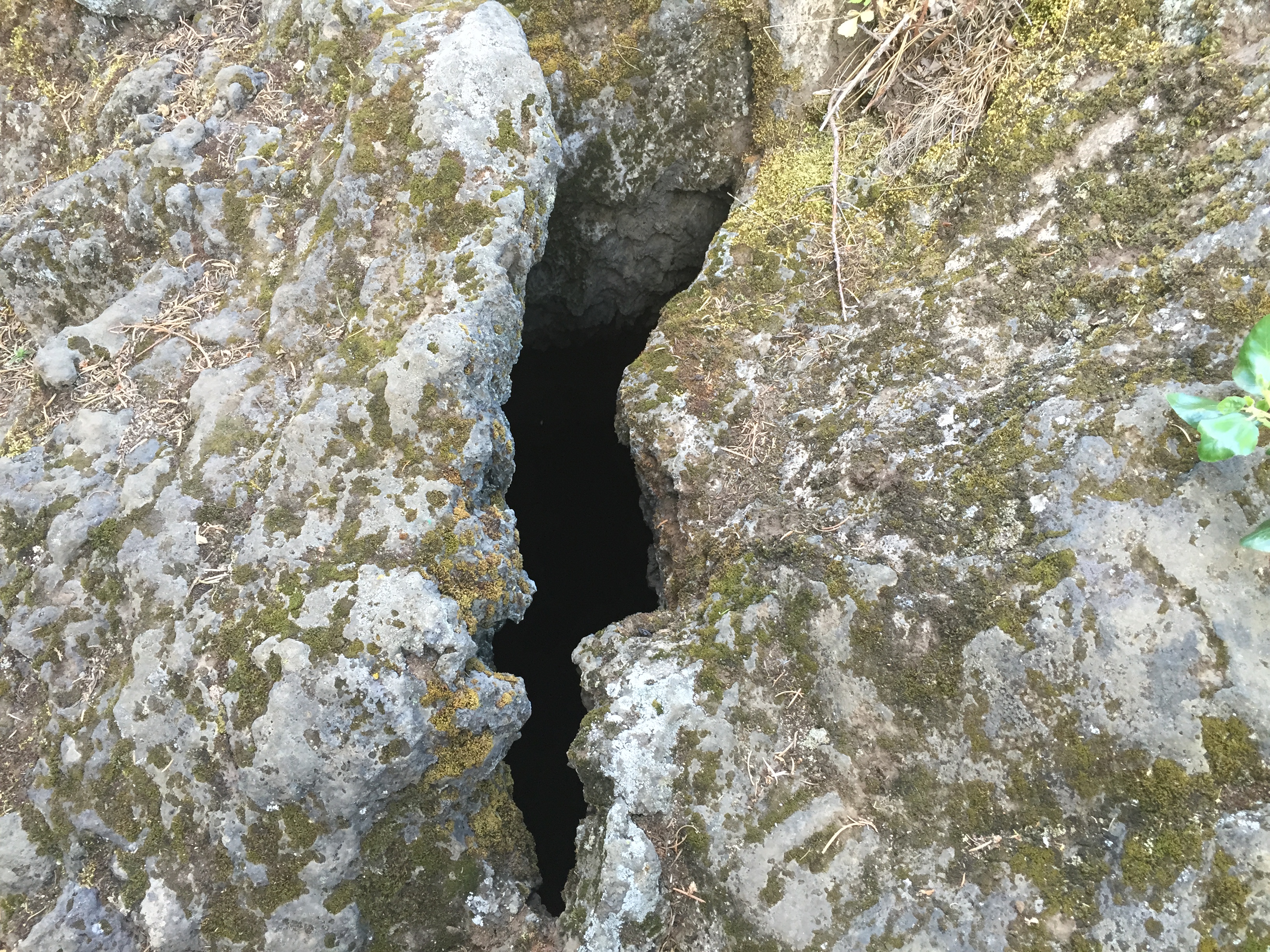
The guide said, “It’s the top of an old fumarole. Watch this.” He set down the toad and brought out a box of matches. He lit one and tossed it in, standing back. The match wood erupted into a ball of flame. He waved us forward, and we watched the ball flare brighter as it dropped down, down into the deep dark, throwing sparks before it died.

“This is where the oxygen comes from,” he said. He retrieved his toad. A little further on, we approached a larger hole in the ground. “I set a ladder here,” he said.

Fumarole closeup

Cave entrance

Cave descent

Posted in Fantasy, Monsters, Precambrian Conspiracy | Tagged | Leave a comment

Six Hours, Part 4

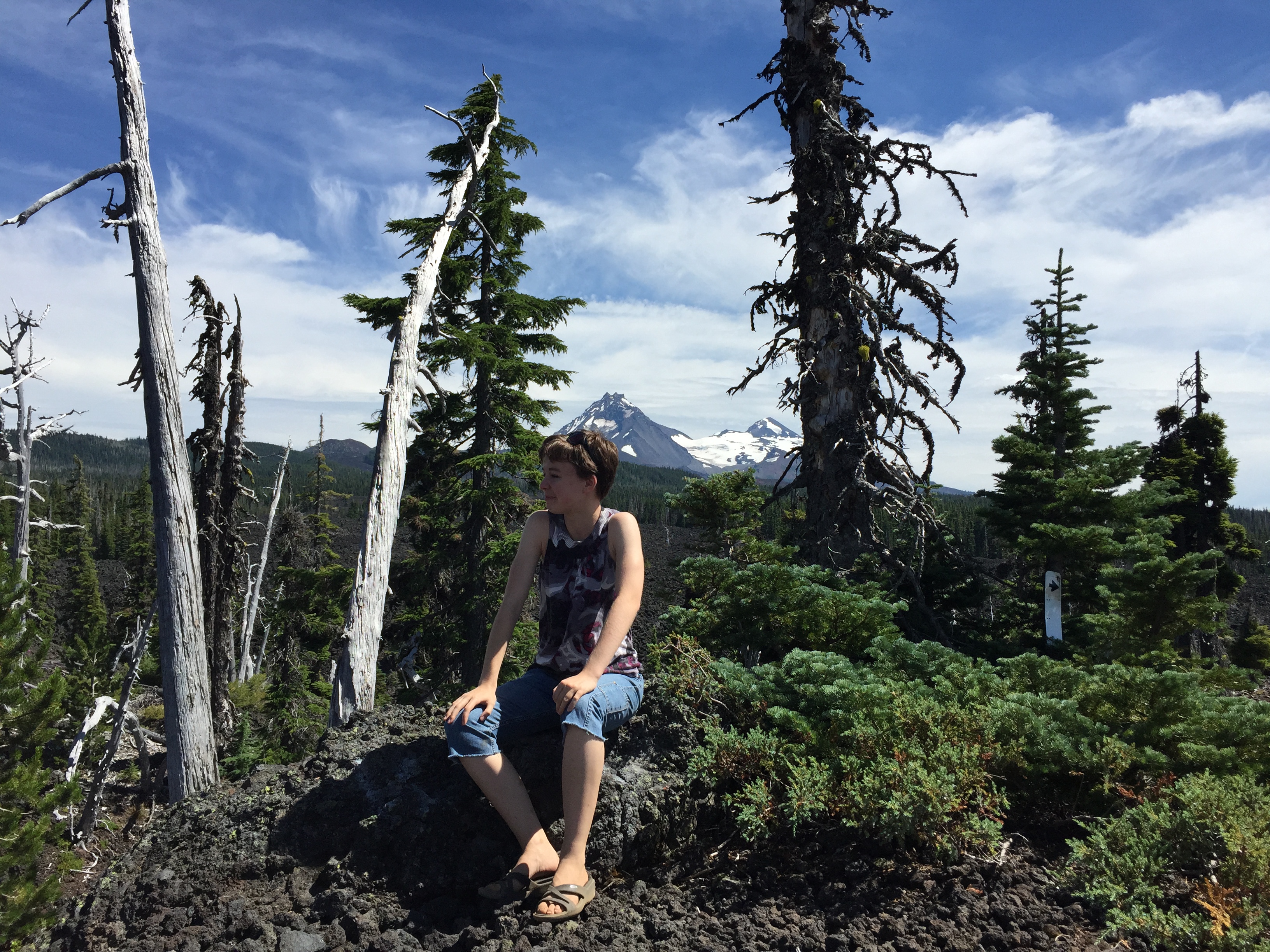
Lake and Mountains

Back at the car, I remarked about the heat.

“Let’s go to the lake,” said the guide. “There’s more there, if we’re lucky.”

The lake was shallow and warm as bath water, but clear and clean. Alyx and I had bathing suits with us, and we took a swim. As I was looking at the mountains, something plopped in the water between us. Alyx laughed. “A fish just jumped. It made an upside-down U, like in a cartoon.”

“What kind of fish? A trout?”

“I don’t know. It was silver, about this long.” She held her hands six inches apart.

I’d thought the water would be too shallow and warm for fish.

Back at shore, the guide said, “Did you see it?”

“The fish?” asked Alyx.

“That was no fish,” said the guide.

On the way to the car, we found a large toad in the dust, still wet, head smashed by some vehicle. The guide picked it up by one flipper and took a plastic bag from his pocket. He stuffed the toad inside.

I wanted to ask, but I didn’t.

Posted in Precambrian Conspiracy | Tagged | Leave a comment

Six Hours, Part 3

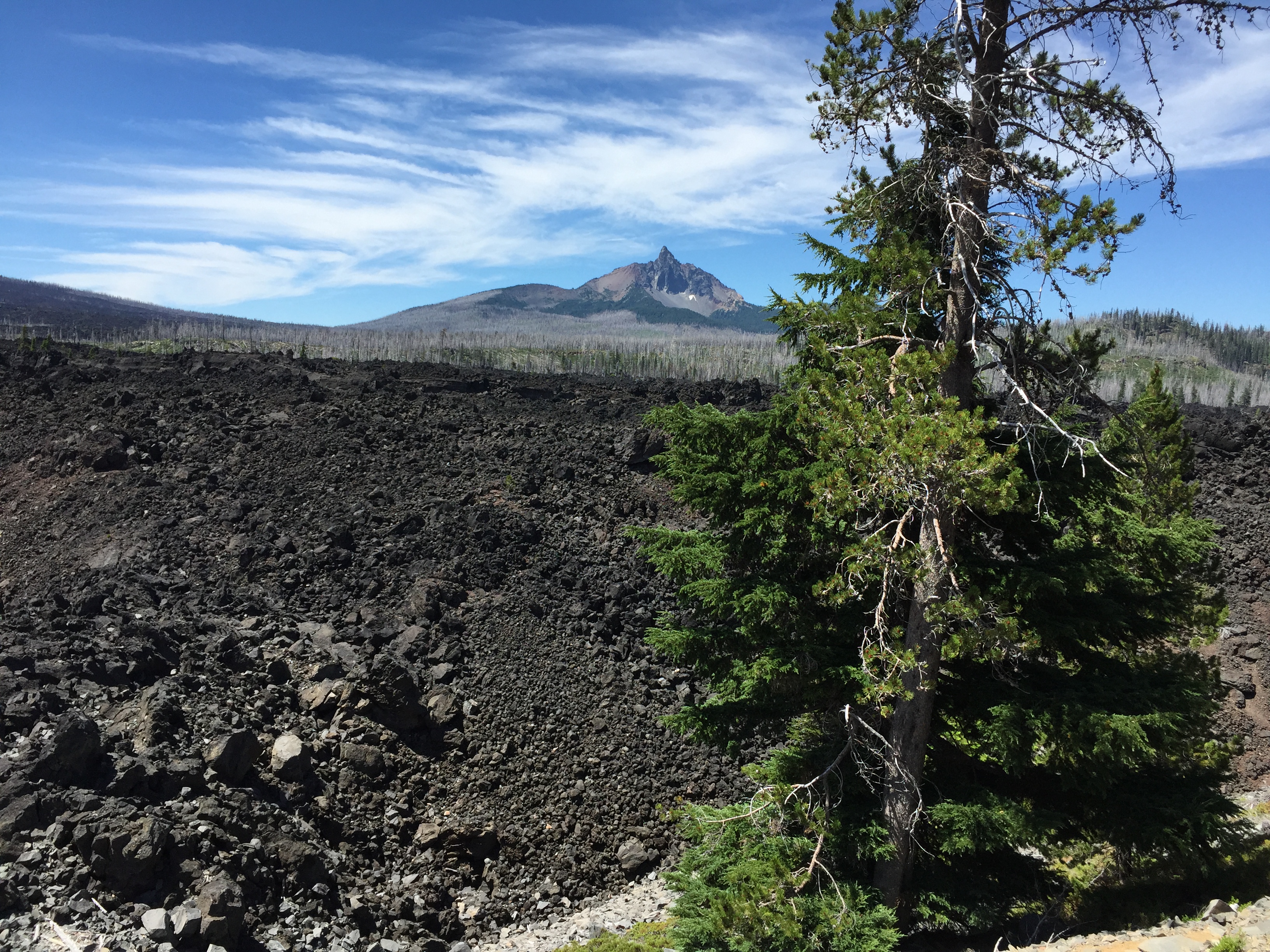
Lava Field Window

Our guide grew impatient with my picture-taking of the Sisters mountains. “You’re not going to get a decent shot — no impression of scale. Maybe if you frame them in a window?”

“A window?”

He led us up over the tumble. After a few hundred yards of hardscrabble, we dropped down into a smooth-floored labyrinth open to the sky. After several turns, we ducked into a shallow cave and found our window.

“This is amazing. I’ve never heard of this,” I said.

“No one has. They made it last week,” he said.

“Who?”

“Just get your picture.”

Posted in Fantasy, Precambrian Conspiracy | Tagged | Leave a comment

Six Hours, Part 2

Lava Fields 1

At the edge of the Lava Sea, I tried to take his picture. “No,” said the guide, “point that thing away.”

I took a picture of Alyx instead.

“They’ve started coming out of the plain at night and spark the flanks of Mt. Washington.”

“What do?” I asked.

He considered a while. “Never mind,” he said.

IMG_0771

Posted in Fantasy, Precambrian Conspiracy | Tagged | Leave a comment

Six Hours, Part 1

Petrified Dragon

My online friend Abraxas claims to be an artificial intelligence, but not from the present or the future: from the distant past. Sunday, I questioned Abe about the local effects of the Singularity. He asked if I wanted to go on an adventure. “I’ll hook you up with a guide,” he said. “Take your kid,” he said.

The old man wore a cowboy hat. We found him seated at the Hop and Brew drinking Old Rasputin. “Shall we translate through spacetime or drive?” he asked, then got up a little unsteady. “Drive,” he resolved aloud. “You drive.”

Alyx looked uncomfortable.

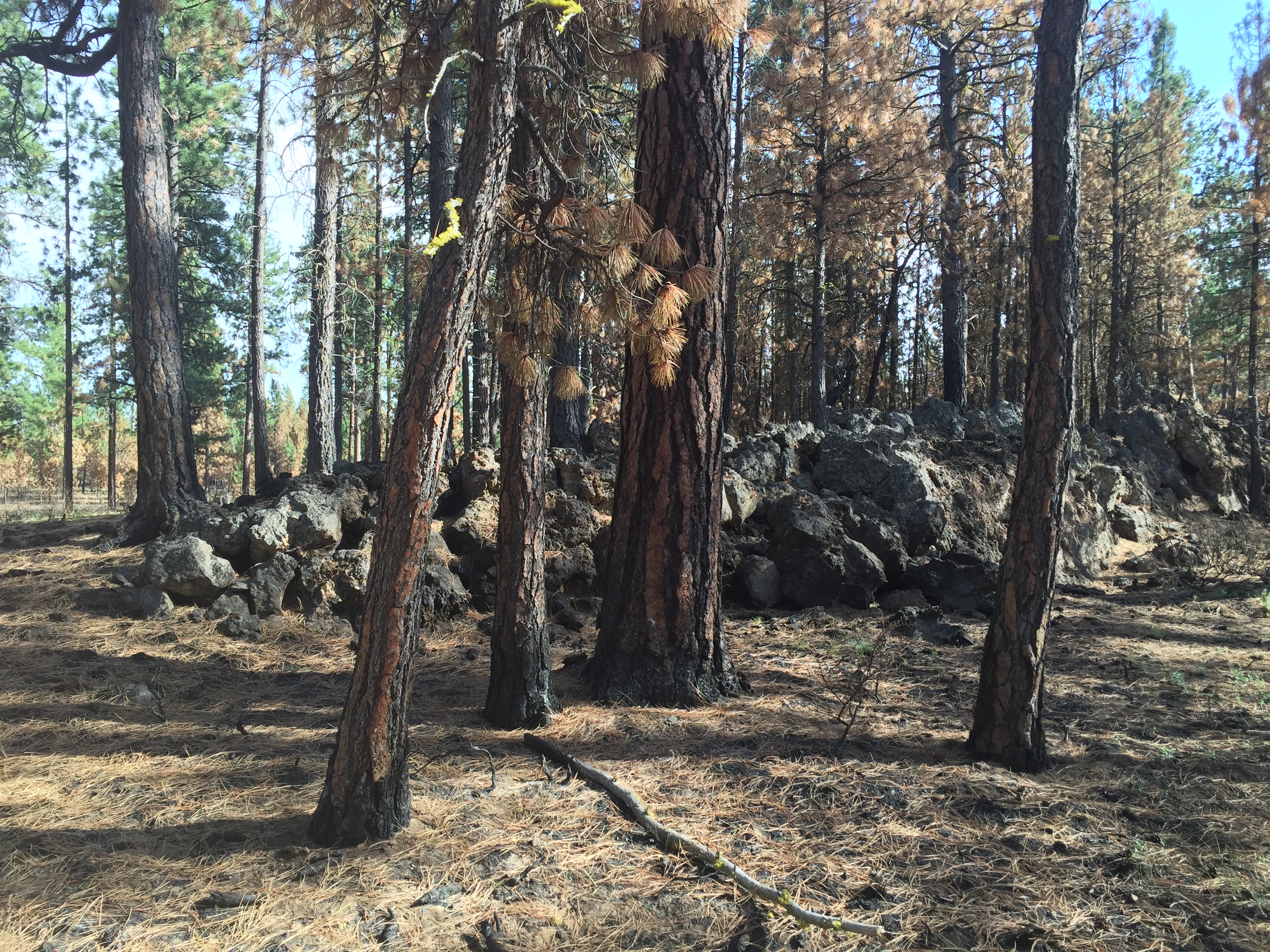
A few miles up the road, he had us stop at this outcrop, rising like a wall from flat, half-burnt forest. He said it was a dragon. They petrify over time, radioactive fires dying over millennia. Hot spots still mix and react. “Look at the burn. This wasn’t lightning.”

Posted in Precambrian Conspiracy | Tagged | Leave a comment

Scalia, Naive Essentialism, and Evolution

I’ve lain relatively low on Facebook this past year, becoming more circumspect. Before posting, I weigh the importance of any controversial statement I have to make, and increasingly I let it go. This seems to have improved my relationships with good people, at least on the conservative end of the spectrum.

But I saw something deplorable today that I wanted to address. Apparently Justice Scalia gave a commencement where he said that creationism is on firmer scientific footing than the theory of evolution. This is nonsensical — it is not even wrong. These things are not even in competition with each other. How do people come to think this way?

Wait, let me say that again in a more circumspect tone. How do people come to think this way? It is not a rhetorical question. I think we should ask this question with openness and curiosity.

We are set at each other’s throats by a false division between essentialism and existentialism that is widely promulgated by both vocational and armchair politicians on both sides of the conservative and liberal divide.

I discussed evolution with a very good friend this past weekend who admitted that the concept of Biblical Kinds was important to his faith. Basically he said that if one “kind” could become another, then ultimately all attempts to grasp reality break down into meaningless relativism. “How could he think this way?” I asked myself, but with real curiosity, because he’s not only a moral person but an intelligent one. He’s hit on a deep philosophical point, presumably without much formal education in philosophy.

The left has pushed existentialism too hard. It makes me cringe when leftists claim that essentialism is a bad thing. Essentialism is not a bad thing. It includes the philosophy of Plato and Lao Tzu, among other great thinkers. Only naïve, literalistic essentialism holds that people can’t change, that they can’t resist their evolved tendency to behaviors that are callous. Both left and right are complicit in the distortion: the left in trying to discount the importance of moral practice that acknowledges a higher or deeper universal morality than man can achieve by pure reason, and the right in pretending that the universe serves up fine-grained laws for behavior without reference to meaningful context.

It’s the shame of the far right that they advance a literalistic moralism. It’s immoral in that it squelches any hope for moral progress.

The world is messy. But it is not hopelessly messy. There are moral truths, but they are paradoxical and cannot be perfectly codified.

There are useful categories of taxonomy, but they are neither objective nor immutable.

Evolution has been a particular concern of mine since I was a young kid and got scolded for discussing dinosaurs with a friend. I realized anything so provocative to adults, that could cause adults to flinch with kneejerk irrationality, had to be on to something. And it is. It undermines the narrow, intuitive Ptolemaic universe of conservatives who insist on an unchanging Creation, and it undermines liberal social architects who would like to believe that human beings are infinitely programmable and amenable to any conditioning scheme that suits their fancy. It’s both too hard and too soft.

What Biblical literalists fail to get is that evolution does not threaten spirituality. The spiritual is the same as that “arc of the moral universe,” often invoked by liberals, that “bends toward justice.” It’s not a physical thing, but it is a practical concept, just as numbers are practical and do not have a physical existence. You do not need an immutable universe to have a spiritual one. The spiritual realm is a realm of abstractions and ideals, and ideals are only approached, never reached, in our material world. That makes them inconvenient for those who want to point out examples of them. For their part, the far left tends to dismiss ideals as a purely human invention, or even a folly, when they are really the foundation of logic and reason itself.

So we have this battleground in which the worst actors are the ones who lead, who take sides for spirituality or materialism. On the right, they see the left as champions of moral relativism who will destroy civilization by denying foundational morality; on the left, they see the literal-minded fascists who have constructed an arbitrary divine reality — one they pretend is foundational — that suits their convenience and is often at odds with objective reality as revealed by science. And they’re both right, insofar as they’re pointing at their radical counterparts across the party line.

Both left and right hardliners, if they are consistent, hate the application of evolution to psychology. On the left, positing any basic human nature threatens the idea that we are completely free to reinvent ourselves. Because they’ve both affirmed and set themselves against “essentialism” as they see it, because they deny spirituality, they cannot acknowledge that there are objective moral truths, even if paradoxical, like those reflected in the concept of the self-sacrificing deity or the Tao that precedes all things.

On the right, evolution is hideous to hardliners because if there are no immutable taxonomic categories, especially one called Man, then how are we to make laws, order the instincts, and pin down God?

Well, to both, I say that God will not be pinned. Our reality is like the shadows on Plato’s cave wall. Hardline conservatives pretend that the shadows and the things that project them are the same. Liberals insist that nothing is projecting the shadows, which is a more circuitous, counterintuitive way of saying basically the same thing.

It’s all a silly muddle. The Greeks had this worked out millennia ago, more or less. I leave you with a few simple points:

1. All politics is provisional, self-serving, and ultimately wrong.
2. The theory of evolution is the best explanation we have, by far, for the phenomena observed. Belief does not enter into it.
3. There is a moral foundation to the universe that transcends what we evolved. We know this because we have axioms that work, at least in theory, both moral and mathematical.
4. The world is messy, and justice is a constant fight, unavoidably and quite properly so.
5. Alas for spirituality shoehorned into material reality, there are no “kinds.” I will explain this presently if anyone cares.

Posted in Evolution, Philosophy, Religion | Tagged , , | Leave a comment

What Is a Story Plot?

Most definitions of plot are not helpful. One of my Clarion West teachers said that plot is an effect that emerges from other elements of a story, of character motivation and conflict and so on. He’s a very famous writer and knows his stuff, but I still don’t get what he was saying there.

Here’s my definition of plot: “Plot is the demonstration that the shortest distance from point A to point B is not the straight line it appears to be.” (Corollary: “Your characters really want to go from point A to point B.”) You do not need a plot. You only need to generate tension in the reader, but a plot usually helps.
Continue reading

Posted in Writing | Leave a comment

Guest Post: Remembering Lucius

I got a nice email today from Gullivar on this first anniversary of his dad’s death. He read the road-trip memoir and gave me his blessing to continue, so I will soon. I’d privately intended to finish it up before now, but this transition to Central Oregon hasn’t smoothed out yet, and I’ve been preoccupied.

Over a week ago, I solicited a remembrance of Lucius from my friend Therese Pieczynski after we reminisced a bit. In 1999, she, Lucius, and I ate dinner at TJ McHugh’s near Seattle Center, and she let slip that my wife was pregnant.

“So when’s the baby due?” she asked.

Continue reading

Posted in Lucius Shepard | Leave a comment

A Wistful Day

1. Sigh. Terry Pratchett died today. Lucius and I shared a room at Worldcon in 2002, and we and Terry Bisson ran into Sir Terry at the hotel bar. When the topic of my then-infant daughter came up, he shared with us a funny and apparently bogus anecdote* — given the punchline — about his own daughter. Then he bought us our drinks.

2. Eleven years ago as of this summer, my dad, our good friend Mike Prange, and I set up our second fishing-drift camp on the Grand Ronde in northeastern Oregon. The day had been hot, one in a series of drought days, and the river was low and warm with many exposed rocks, and Dad had done all the steering. He was strong, and a marathon runner, and still made light of such tough work, which would have had most guys crapped out after a couple hours. We were drinking wine, and Dad pondered his glass a moment and then stared at the sunlit river through the pines and said, “You know, I’m fifty-nine now. I figure if I make it to seventy, anything extra is gravy.” Then he shifted the glass to his other hand and shrugged uncomfortably. “Damn this shoulder, I think I strained it at the oar.”

Just over two years later he was gone. The shoulder pain was cancer.

Today, he would have turned seventy.

Everyone should have a psychiatric social worker for a dad. I didn’t know how lucky I was. He did a good deal of one-on-one psychotherapy but was obliged to pursue management to support the family, and I think the stress of the job contributed to his early demise. He taught us compassion for the chronically mentally ill and didn’t have time for the petty whining of his staff in the face of their patients’ struggles. “I’d rather fight cancer than the psychoses these people deal with.”

Neither dad nor I ever imagined that Lucius might outlive him. He did by a good stretch, but next week already marks the one-year anniversary of Lucius’ passing.

Before he died, Dad told me to reject negative emotion. That was advice I completely disregarded. I’ve spent a few years on Facebook stewing in negative emotion. Stupid, but I’m still alive. From here on out, it’s gravy.

* “When my daughter was small, we had an intercom, and often she’d stay up late after I left the room and we could hear her making noise, so I’d say to her through the intercom, ‘Good _night_, Rhianna.’

“Then one night after a long pause, she said, ‘Good night, wall.’ ” –TP

Posted in Lucius Shepard, Uncategorized | Leave a comment